I have had so much difficulty in motivating myself to write about my 2008 rerun album this particular season, so I have decided to skip right to the album I chose for 2007 instead. Along with Radiohead's In Rainbows (which I gave the top spot in my top 12 albums of the '00's and wrote about here), there is no question in my mind that the album of 2007 I'm most likely to 're-run' is Bon Iver's debut For Emma, Forever Ago.
Not only did For Emma shape what we would expect from Justin Vernon and the rest of the Bon Iver crew, it also seemed to speak directly to our hearts (especially of the broken variety) through barely-comprehensible lyrics and sparsely produced acoustic guitar. The truth is, we tend to love an album with a story, and this album has a particularly good one. Vernon had hit rock bottom with both his romantic relationship, and his band at the time. Carrying his grief and pain into solitude, he decided to process by moving to a secluded cabin to write, play, and record some songs. The result: an album of intimately expressed and beautifully written tracks full of atmospheric tension.
The record begins with Flume, a song covered by none other than Peter Gabriel himself. See what you think of that, here. I'm not sure what I think about understanding all the words in this song, since part of what draws me into the raw emotionalism of Bon Iver's music is the way his Vernon's voice makes it hard to make out the english words. There is a sense that the only language that is clearly being spoken is that of music, and when a word or phrase does break in to my consciousness, it becomes especially meaningful. One of the clearest sounds in Flume is a muffled echo, reminding me that when grief is most poignant, sometimes nothing else sounds clear.
Although Lump Sum begins with monkish motet-like harmonies, the song picks up with a faster pace, without losing the sadness that permeates the entire album. The echoey sounds continue in the harmonies, and the song fades perfectly into Skinny Love, arguably the most popular song from For Emma..., and for good reason, since few break-up songs are able to so honestly hold in tension such raw emotion with thoughtful reflection.
The Wolves (Act I and II) slows down and emphasizes harmonies that remind me of Fleet Foxes. It moves from being nearly the sparsest track on the album, to being the most dense, complete with a horn section and chaotic drum set solo, and finally returning to the sparse voice and guitar feel it began with. I feel as though if I took a bit more time with this song, I would find all five stages of grief represented. Someone else can do that though. I'm moving on to my first love of this album: Blindsided.
Just this listen through, I realized was how clear Vernon's vocals are on Blindsided. It seems as though the only thing he can make sense of verbally is his feelings from being blindsided, and his continual reeling from the shock.
Creature Fear and Team are two songs that carry the most volume and energy on For Emma, but instead of coming across as angry, they sound confused and desperate. Team is also the one lyric-less track on the album (though Vernon's voice and whistle can still be heard), but I hardly notice this because of how Vernon treats his voice already like one of the instruments.
For Emma seems as though he has moved to a point of considering closure. Don't get me wrong; he's still fairly bitter, ("Go find another lover... to string along") but the relationship feels "forever ago". My favourite part of this song are the horns. The strumming pattern gets old, but it does carry this sense of moving forward, one step at a time. If the album ended here, I think it would sound like a fabricated happy(ish) ending, but luckily it does not.
Vernon ends with an "excavation" - Re:Stacks is a reflection that questions the entirety of his lost relationship. He plays with the metaphor of gambling in a way that is full of both sadness and hope. Hope, because there is a hint in the last line that the album itself is a part of the process towards moving on. He may have hit rock bottom, but he knew exactly where to channel that painful, chaotic energy: into an album that wrestles with his fears and griefs vulnerably and honestly. This is an album that I will return to, not only when I am at my worst, but perhaps especially when I am.
Showing posts with label indie. Show all posts
10.15.2012
1.01.2010
#3) Sufjan Stevens: Come On! Feel the Illinoise!, 2005
But I don’t find the album’s American prairie setting excludes me completely as a west coast Canadian, because ultimately the album’s true concept is a collection of short stories of human life meshed with Stevens’ touching personal reflections. Just as a good movie can do, specific setting is used to create a fairly universal story. And story is one of the many things Illinoise does incredibly well; it is folk music at its absolute highest caliber.
Although it is somewhat ambiguous from the first two tracks, Illinoise quickly shows itself to be the happiest sound on my list, and arguably the entire decade! Even tackling heavy subjects of war and murder, there is a lightness in the exquisitely eclectic instrumentation, and a sense of humor that comes with ridiculously long song titles. (For the purpose of time and space, I’ll use abbreviated names unless absolutely necessary).
And so we are introduced to Illinois/Illinoise with reflective piano not constrained by any time signature used in pop music prior (65/16. And no, I don’t want to admit how long I spent on that), preparing us for a collection of songs that refuse to fit into any box. Flutes trill above the texture freely, until they go crazy in The Black Hawk War, a march complete with snare shots doubled by trumpets.
Both tracks to me feel like a slow approach to the listener, before full out inviting us to indeed “Feel the Illinoise” with the title track, which is broken into two parts: The World’s Columbian Exposition, and Carl Sandburg Visits Me in a Dream equally portray some of the most joyful energy, even as both parts question the meaning of progress in light of the world fair and transitioning to a more personal inquisition inspired by the poet Carl Sandburg: “Are you writing from the heart?”
While this album creates an atmosphere easy to play in any background, it can additionally be appreciated musically and lyrically for hours. For months I didn’t pay attention to what John Wayne Gacy Jr. was about, and when a friend pointed out that he was a famous serial killer I was eager to listen to the lyrics more closely. Sufjan has a way of empathizing with both victim and victimizer, turning the final line into an introspection: “and in my best behavior, I am really just like him, look beneath the floorboard for the secrets I have hid”.
Jacksonville through Decatur (the first song I know of positively dedicated to step-mothers!) have a great southern banjo flavor that is only briefly interrupted by A Short Reprise of strings (which tie the entire album together, without sounding too formal) that flow straight into the best-known and loved track on the album, Chicago. Oh how I need to go to Chicago. In the past, I’ve mostly wanted to go so I could have my picture taken with the bronze Michael Jordan outside of the United Center. I still want to do that, but now I just want to duplicate an experience of a van road tripping and sleeping in parking lots like described in this song.
More sensitive story telling with Casmir Pulaski Day, showing what has been consistently true of Illinoise; Sufjan’s beautiful sense of both melody and harmony. Having a brief instrumental break before The Man of Metropolis jars us back into interest with a few beats of an electric guitar that doesn’t find its way back into the track for a full two minutes. The variety in instrumentation is noted yet again, as The Prairie Fires return to a Sufjan-favoured combination of oboes and muted trumpets that finds itself displayed in all of its glory throughout the Predatory Wasp as well. And for the sake of trivia and awe, Sufjan himself plays nearly every instrument in the recording of this album.
As Sufjan continues to sing his simple and deeply honest lyrics, it occurs to me that there is something about his voice that doesn’t quite fit in with the other artists on my top 12. Thus far it has seemed that one of the most consistent themes of Listmas has been men making use of their falsetto range. Think about it: Falsetto is practically a trademark for Justin Timberlake, Thom Yorke, Chris Martin, and Jonsi Birgusson. Yet Sufjan’s voice is under-produced, softly calling us to pay attention to his insights. Not that he never hits a high note, but there really is something quite noteworthy how unremarkable his voice really is. Yet we love him for it, and the way it seems to welcome us all to sing along with him.
This album also plays rather like a movie. It’s certainly long enough to be a feature film, and as we near the end, tracks like Night Zombies and The Seer’s Tower turn dark, seemingly more at home on the earlier album Seven Swans, which is a musical interpretation of the Biblical Revelation. The ghostly part of the album doesn’t last long however, and we return to another 2 part-ed song full of energy and joy as though we really haven’t departed to far from the title track. Even the transitions between the two parts finds itself made up primarily of falling trumpet lines, while Illinoise transitioned by rising ones.
In noticing similarities between Illinoise and The Tallest Man, I begin to wonder if the whole record is set up in a chiastic structure, since they match also as the third and third from last song on the album. This would make The Man of Metropolis Steals our Hearts the most important track through which to hear the rest of the songs. Interesting, but I’ll have to leave that analysis for another day, and instead try to remember whether Sufjan Stevens was in my Orchestration class as we also had to write an exercise of riffs using a single note. Either way, he cheats a bit.
And so beautifully, Out of Egypt concludes the experience in a wonderfully Steve Reich influenced instrumental repetition that fluctuates slowly and covertly. It allows me to put the whole experience down for a while and reflect before I decide to pick this album up again. Sounds take their turns emerging and re-submerging into the texture as all that makes up Illinoise seems to be waving wide-eyed goodbyes.
In a decade of emo and self-pity, Sufjan asks his questions of meaning not with naivety, but with refreshing hopefulness. Easily one of my favorite things created this decade, and absolutely my favorite new creative genius from these past 10 years.
12.27.2009
#6) Sigur Ros: Takk..., 2005
And what a thank-you it is, whether this album is meant to be directed to life itself, or god, or loved ones, the entire album is packed with beauty and a magical sense of thankfulness for all that is around us. At least that’s what I feel when I hear it.
Today I needed to experience the great outdoors. It was an absolutely beautiful, clear, cold day in Vancouver, and I had only been out to buy groceries and empty to compost bucket. I knew I would be listening to Takk... this afternoon, and that it’s not a terribly productivity inducing collection of songs, so I put my headphones on and journeyed out into my neighborhood before darkness would inevitably take over. It was a good plan. I’m sure that it didn’t hurt that I headed out during magic hour – just as the sun was beginning to set and bathe our icy streets in warm orangey light – but it also is true that noticing and imagining beautiful things is not an uncommon activity when Sigur Ros is in ear-range.
I took my camera, and even thought about making this one a photo blog, but alas my batteries died, and Beth took the card-reader on her Christmas vacation to Saskatoon. Perhaps another time with one of Sigur Ros's many fabulous records.
Takk… like the majority of Sigur Ros’s music is extraodinarily ethereal. I knew right away that they would have to make my listmas, and simply chose my favorite album. I’m sure my going out near dusk must have persuaded my mind to consider that this album expresses a kind of threshold experience. It can’t just be me either, since the cover art pictures a stencil of a person walking under an archway of tall plants. The songs themselves effortlessly bleed into one another, and as transitions are made within pieces, sometimes I’m not sure whether or not a new track has begun. The music on this album creates a mystery that reminds me of Narnia’s wardrobe. "Glosoli" in particular has me wonder if the air around me is an illusion, and if I look close enough I might find a hatch into some magical kingdom. I feel like a little kid.
As I zig-zag through the streets just east of my house I’m full of wonder for the world around me. I'm terribly aware of my inner-child whenever a xylophone or the higher octave on the piano is played during the first several tracks. "Hoppipolla" makes me want to dance in the rain, as does the next track, "Med Blodnasir"; "Se Lest" makes me want to run through a park with a kite or maybe a dog; "Saeglopur" makes me want to climb a tree and yell at the top of my lungs; all of them make me wish I were listening to this CD in a giant sandbox or cushion-made fort. If A Rush of Blood to the Head was black and white, Takk… is the opposite, full of life and colour and magic. It’s really only a matter of time before a feature film decides to use Sigur Ros alone for their soundtrack. I’d watch it, no matter the premise or plot.
"Milano" strikes me as slightly more reflective than the other tracks, and though I can’t understand the lyrics I find myself thinking of Christmas Day in all of its chaos, remembering the beauty and love that I have experienced through my nephews and niece. (My, they are working their way into this blog more than I expected!). "Gong" changes pace and mood, adding to the dream-state a sense of threat, as all great fantasies must have.
12.23.2009
#11) Death Cab for Cutie: Plans, 2005
Honestly I know, they are more than a little emo, and Ben Gibbard isn’t the most amazing singer who has ever graced even an Indie band. However, there are moments that call for Death Cab above anything else. Recently, I arrived home to Beth, who had been writing most of the day and was beyond tired and fed up, and asked me to put some music on that was neither depressing nor upbeat. I had to scroll through (and suggest) several artists before we settled on this particular album. It was perfect.
Now, I do realize that to some they could be considered depressing, but their music is not so reflective that I tend to curl into fetal when it’s on, losing all hope in life like I do with say, oh, Damien Rice for example. Interesting that I say that, because one of the strongest themes on plans seems to be growing older, and expectations not being met. That sounds pretty fetal in theory, but it turns out sounding more thoughtful and less self-pittying than fetal normally allows.
Getting to the music, Marching Bands of Manhattan is the best way this album could have started. It builds up anticipation inside of me, not necessarily for the rest of the album, but for anything - anything - to happen. Something about the mix of instrumentation and timing give me an inner sense of purpose, even with lines like “sorrow drips you’re your heart through a pinhole… your love is gonna drown”. Perhaps these lines are warnings for my increasingly Emo music taste in the middle of this decade. Yes, I was listening to Dashboard Confessional too, and no you won’t find them on the list. (On another note, I have brushed my hair over my face in a rather effective emover for the event of writing this blog, and I do believe it is helping.)
Next comes a string of great tracks beginning with Soul Meets Body and reaching a sort of climax with the acoustic I Will Follow You into the Dark. Quick side note: my favorite lyric on Soul Meets Body is “I know our filthy hands can wash one another’s and not one speck will remain”. In between these include a track of nostalgia (Summer Skin) and another of melancholy thoughtfulness (Different Names…) before the chord pattern strikes up for I Will Follow You into the Dark; a title and chorus that are hinted at earlier with lines like, “but if the silence takes you, then I hope it takes you too,” and later echoed in the weaving of two central themes: death with love.
I have often thought the album sort of dips down to a low point until it hits What Sarah Said, but I noticed “Your Heart is an Empty Room” this time. For the first time I recognized its stunning beauty next to I Will Follow You into the Dark, potentially offering another response to the end of a relationship. It seems to be an outsider's point of view on a relationship, with the opinion that one does have the opportunity to start fresh, as awful as it may feel.
Crooked Teeth was probably the biggest single from this record, and I honestly cannot tell you why. It’s a little fun, but the number of times I skip this track far outweigh the number I sit and listen. Maybe because by this point I am only waiting for What Sarah Said: my highlight of the album. Here we finally discover how the album's title Plans, works. “And it came to me then that every plan, is a tiny prayer to father time…” Written from the perspective of a loved one sitting in the waiting room of an Intensive Care Unit, this beautiful track hit me hardest during the summer of 2006 when I watched my good friend question daily for weeks whether his wife would make it out of VGH. She did, but I still can instantly see his worn, unshaved face when I hear Gibbard almost whisper, “love is watching someone die.”
Then, there is just enough musical interlude to force you to reflect on the implicit question that will eventually be explicitly sung: “who’s gonna watch you die?” Not accusing or mean in anyway. Ben almost sounds like he actually cares about me.
And he does. Well, he cares enough to cushion the album with a couple more songs that pull me out of “what Sarah said” and not remain fetal the rest of my day. Not that Brothers on a Hotel Bed doesn’t deserve some thought and interest in it’s own right, but at the moment I’m tired, and can’t talk too long of beds without climbing into one. Basically it’s more on the obvious themes of the album, and it’s catchy.
And then the album ends. With Stable Song, which is really not much more than a somewhat un-striking yet appropriate ending. Perhaps a little too self-aware with an opening line like, “time for the final bow”, but I forgive it fairly easily, because just as the song admits in it’s conclusion, “the gift of memory’s an awful curse, with age it just gets much worse, but I won’t mind.”
Ps. I do realize that I am now officially over a day behind in this blogging project. I might try to catch up with myself, but I also might just ignore it and end on the 1st of January. I got over my unmet expectations, and hope you can too. ;)
Peace,
10.26.2009
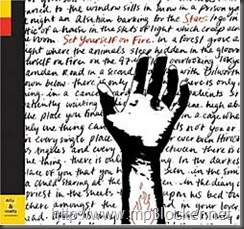
Stars: "Set Yourself on Fire", 2004
It really wasn’t so many years ago that Set Yourself on Fire was left on repeat on my stereo for several months, and even now I don’t feel as though I’ve exhausted its effect on me. The sentimentality of the record is varied in such a way that it seems to fit any circumstance: it’s great on my iPod, on a road trip, or while I’m at home studying. Or like this Friday, cranking out the stereo as I prepared brunch for myself and a friend.
Before I say too much, I should mention that as soon as I put this album on I am automatically in danger of completely contradicting my philosophy of albums and the intention of this blog. The reason being I could quite easily spend the entire post on the first track, Your Ex-Lover is Dead. I’ll try to keep it short. Your Ex-Lover is Dead provides a window through which to view the rest of the songs of the album, and sets the tone for what the album (and the band in general) is best at: break up songs.
The song showcases Stars’ two lead vocalists Torquille and Amy, by having them play the parts of two departed lovers. Before we know anything of the intended setting, a string section and a cello line sets a mood that paints a picture in my head. And even though I'm sure it's influenced by my foreknowledge of the lyrics, I’m immediately transported to a rainy evening on a cobblestone street, trying to hail a taxi.
It’s also hard not to hear this song without mental pictures of the film, Eternal Sunshine of the Spotless Mind, but I’m positive that’s only because the music video makes pretty clear references to it. Other great things about this track: the shift between a lighter 6/8 feel characterized by the orchestral strings and a more punchy every-beat-emphasized feel in 3; along with great bitter-sweet lines like, “I’ll write you a postcard, I’ll send you the news from the house down the road from real love”.
But moving on to the title track, Set Yourself on Fire. It’s a fairly smooth transition actually, partially because the intro of the song keeps a meter in 6/8 before snapping back into common time for the verses. What this song does really well is move us from the beauty of the first track into further exploration of failed relationships through the rest of the album by unifying the world through experience of the “one thing”, which of course is up for interpretation, but not really.
I begin to pull out ingredients for hash-browns, but about 3 minutes into the song I’m tempted to crawl back into bed to add to my “20 years of sleep”. Thankfully, by the time I convince myself, Ageless Beauty kicks in and reminds me that Sarah will be at my door in about 20 minutes, and I need to chop some freaking potatoes! So I do, to a slightly more poetic and hopeful view of love and life (“we will always be a light”).
Reunion comes next, reminding me that I have one myself to look forward next year: Ten years past high-school. I’m not so sure that I’ll go, but for now I’ll enjoy this song about nostalgia for old crushes and youthfulness.
Then, once again, Stars play off their duet capabilities in The Big Fight. These are always my favorite songs of Stars. This song is relaxed and groovy, and even though I’m spending my time boiling potatoes, I feel suave. I kind of imagine myself sitting by a fire with a stiff drink in hand. But then the mood breaks a little when I picture Torque and Amy acting out their disagreements through a dance off during the long instrumental outro…
All I can say about What I’m Trying to Say is that I find it impossible not to sing along with. It captures an awkwardness of relationships that songs rarely can without sounding awkward themselves. “I am trying to say… what I want to say… without having to say… I love you” So great.
Sarah arrives and I make her help with all the brunch that hasn’t been finished, while I also lose my focus on the music playing in the background. Instead of ignoring my friend to blog, I wait and put the CD on at work during the evening shift.
One More Night (Your Ex-Lover Remains Dead) gets even deeper into the complexities of end-of-relationship phenomena: The last night together. It’s dark, and I love it. I also love how it’s back to back with Sleep Tonight, the one fairly simple, love song on the album. Yet even on Sleep Tonight, we’re aware of what we’re ignoring: “with buried heads we both forget all of the past and its regret”. Still, “all the love’s alive tonight”. Maybe it is still possible to love after all of the disappointment and pain that we’ve been experiencing.
Nearing the end of the album, we get a brief picture of a beginning of a relationship: The First Five Times. I’m not nearly as into it this time, but in the past it’s been one of my favorites to bounce around to.
He Lied About Death is just plain angry. I have never loved this song. Sometimes I yell to it a bit, and it was a little fun listening to at work, but for the most part I don’t see how it fits with the rest.
Finally the trio completes it all: Celebration Guns, Soft Revolution, and Calendar Girl. We have another clear return to the strings and brass that began the album, creating a bit of a nostalgic and reflective tone. Next Soft Revolution jumps back in to the familiar steady beat to get us ready for the ultimate end-of-album ballad (Calendar Girl) that spends some time repeating that, after all is said and done, I am alive.
So in the end, Set Yourself on Fire is relatively hopeful and thankful for life, allowing the title to take an ironic tone. Maybe we can survive our broken hearts and failed attempts at love. And even when it feels like we won’t, we have a great album to relate to.
Peace,
Danice
Labels:
album,
amy millan,
canadian,
indie,
ohsies,
pop,
set yourself on fire,
stars,
torquille campbell
Subscribe to:
Posts (Atom)